76k Verbier Trail Run
In 2022 I embarked on the 2022 X Traversee UTMB, a 76-kilometer race in Verbier organized by the UTMB. In this post, I share the beauty of this trail, the difficulties that I overcame to complete and in doing so, should help other runners prepare to overcome this challange, as one-in-five does not make it to the finish. I will go over the environment, the race, the trail and the gear.
Environment
The X-Traversée is an epic trail running event organized by the Ultra-Trail du Mont-Blanc (UTMB) organization. It is a challenging and adventurous journey that crosses the Alps from west to east, covering a distance of approximately 76 kilometers (47 miles) with a total elevation gain of around 5,300 meters (17,400 feet). The route takes you through breathtaking landscapes, including alpine meadows, rugged mountain passes, and picturesque valleys. The UTMB® X-Traversée is known for its demanding terrain and stunning scenery, attracting trail runners from around the world to test their limits in the heart of the Alps.
During the UTMB® X-Traversée, you can encounter a wide range of weather conditions due to the varied terrain and high-altitude passages. Weather can change rapidly in the Alps, presenting runners with hot and sunny conditions in the valleys, while encountering cold winds and chilly temperatures at higher altitudes. Fog, rain, and thunderstorms are also common, adding an extra layer of difficulty to an already demanding race.
Race
It’s a tough and well organized race.
| Year | Participants | DNF rate (%) | μ Finish time (hours) | Distance (km) |
|---|---|---|---|---|
| 2018 | 807 | 19.3 | 16.4 | 74.7 |
| 2019 | 774 | 26.0 | 16.8 | 74.5 |
| 2021 | 582 | 16.5 | 15.9 | 74.5 |
| 2022 | 625 | 19.7 | 16.9 | 76.0 |
| 2023 | 1249 | 22.9 | 17.2 | 76.0 |
The field has grown fast: 2023 more than doubled 2022’s field size, and the course distance has crept up slightly over the years too, from 74.5-74.7km to 76km. What hasn’t moved is the DNF rate: it sits in the 20-25% range in every year shown except 2021 (16.5%), regardless of field size or the small distance changes, which says more about the terrain than about any single year’s conditions. For more numbers like this across the UTMB’s entire race calendar, not just this one, see my UTMB World data project.
Trail
The trail is highly technical and especially the final climb dubbed “le Mur” (the wall) cannot be overestimated. Below you see the altitude throughout the trail with my pace colored: the first two climbs are still fast, but you can see exactly where the third climb, from Brunet to Panossiere, started to hurt, and where Le Mur turns dark red at the end. I can still clearly remember those sections.
The race breaks down into four major climbs: the first climb followed by a descent into the valley, a second climb with its own descent, a third up to the highest point of the race, and finally the wall.
In the lead-up to the X-Traversée I had done the Marmotte Ultra, a roughly 240km cyclosportive that climbs Alpe d’Huez twice, and gone straight from there to a conference in Zurich. The following weekend I traveled from Zurich to Verbier and set up camp alone in a tiny, cheap wooden lodge.
I took the first bus because there were two, and I did not want to miss it. So I was there at 7am, an hour before the 8am start, which was a bit cold, so I put on my gloves and buff and tried to sleep a bit.
The start was exciting, riling up the crowd, doing X-signs with our arms, with some runners blowing big horns. Starting at 8am is comparatively nice, with no running through the night like some other UTMB races, and even though everyone was fired up, lining up went quickly, no rushing needed.
We started running on asphalt with a mild incline. This led us to the first climb in a long line up the mountain, with quite a pace. This was already a long climb with an incline over 10%, with sections up to 30%. It included a loop around the valley before the St. Bernard Pass, a spot I already knew, having cycled over it years earlier on my bike trip to Rome. I had been here before by bike, but the best thing was still the asphalt. Then the first great descent starts. I was primarily occupied making meters, then the descent starts to a lake at Bourg Saint Pierre. I tried to set some intermediate waypoints. The first 27K was easy, then the second big climb started. In Bourg Saint Pierre was the first aid station, in a gym hall that had been kitted out for the race. I hadn’t researched the race that much, and didn’t know what to expect, but I was pleasantly surprised: it was like a buffet. People sat down to undo their socks and I thought HOW MUCH TIME DO THESE PEOPLE THINK THEY HAVE, because I was somewhat in a hurry to finish. I had in mind to finish in 12 hours. There were already muesli bars at the first drinks stop at the St. Bernard Pass. In Bourg St. Pierre I threw these into my pockets, which was about as much as I could take at this point.
The second section was the climb from Bourg St Pierre, at about 15%, but this path was a lot better than the rocks in the first part, which helped me get into my zone. I went a bit faster than people around me. I had an asymmetric gait at HR 145 while other people were already at a symmetric gait. I descended to the next stop (I can’t remember its name) at 45km.
At every stop I just drank as much as I could, and refilled my 500ml water bottles, which meant I could avoid topping up the water bladder in my bag, which was a lot more of a hassle to refill than the bottles.
Then I was at KM 37, and for me, the first marathon distance was a milestone. I experienced a bit of a setback because the first marathon took me about seven hours, which made me calculate that the whole ordeal was going to take quite a bit longer than expected. I felt like I was overstretching my foot every so often.
Then the third climb starts. KM 45-50 is only up, which really started to get tough with gradients from 20-40% in the final stretch. There were people in front and back of me so I wanted to keep moving. My shoulders started to get stuck and I did not want to take time from drinking and eating. I finally reached the top, from there you can see the Combin de Corbassiere. At the peak I decided to drink some and eat lower. The plan was to eat at the bridge, or failing that on the flats, but I couldn’t eat at the bridge, and the second spike of the third climb had already started. It started to get tough, I reached Panossiere, and just then ran out of food and drinks. This was where I found the first people quitting.
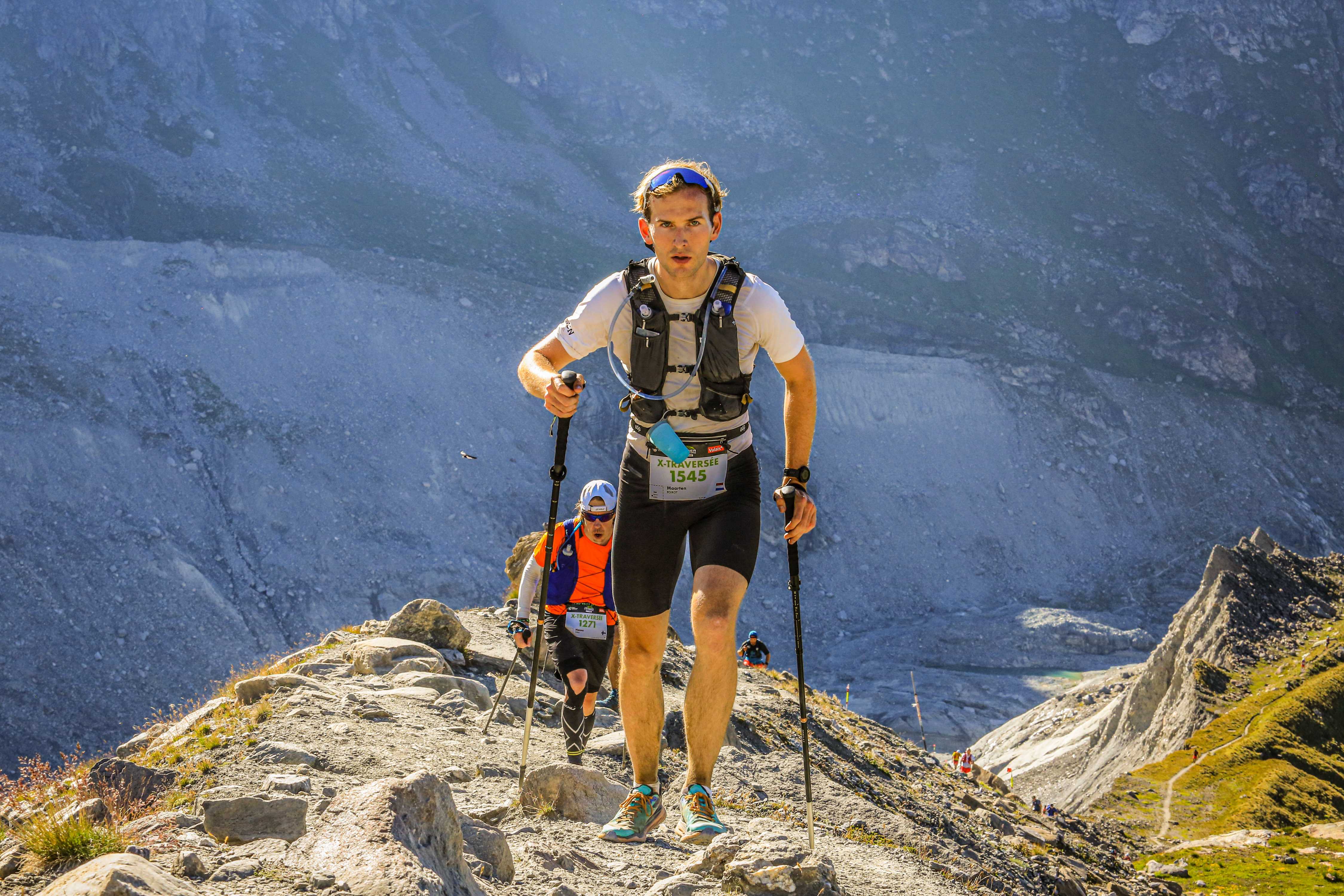
I took a look at the map, which looked great because it was just down from here. However, what I had not realised, and a Frenchman told me, after that it would be another two hours of climbing. I did the descents. I had expected a stop at 60K but the stop in Lourtier was only at 64K. At this point I started to get motivation from the idea that I was finally getting there.
The final section contained Le Mur between kilometers 62-70, a single climb from just over 1,000m back up past 2,000m. I had hoped to reach it while it was still light, but the sun was setting in the valley, and I had to let that idea go. A mountain like that doesn’t care how much energy you’re willing to spend; it goes at its own pace, not yours. On the way up I passed a lot of people just sitting on the side of the path, clearly cooked. My only rule for myself was to not stop walking, no matter how steep it got, and that got me, slowly, all the way up to La Chaux. I was following a girl with a steady pace and decided that I just did not want to stop for a second. Then I started to pass people at double speed; it must have taken them hours. I thought this climb would lead straight to Verbier, but I still had to do a short descent to reach the finish. Just before the finish was the final station, which just had SOooooo much food and nice stuff, it was really overwhelming: cookies, chocolate, soup, pasta. The food stations were probably the best part of the whole race; by the last one I genuinely felt like I could cry from how good it was. Here, I sent a quick message to my parents. During this descent I started noticing a blister, which made me compensate a bit. Later I found some other blisters that had not bothered me. At this time my pace was still average, I was still able to run the downhill. My shoulders were very stuck from the poles, and I should have trained that ski-erg motion more beforehand.
Finishing, I had mixed feelings. My finish photo is timestamped 23:56, four minutes before midnight, just over 16 hours after the 8am start. I had gone in hoping to finish around 8pm, in about 12 hours, and missing that goal by such a wide margin got me down for a bit. But this was my first UTMB race, I finished in the best 40% of participants, and since it was dark and the spectators had gone home, it felt like finishing a marathon in 5 hours when the streets are already being cleaned: quiet, but not a bad result at all.
Final thoughts: do not let your expectations get you down. The real lesson was to stop overestimating how fast I could go and to respect the terrain instead of racing the clock: the mountain is always the boss. My gear held up perfectly the whole way. If I did it again, I’d want to be lighter in body weight and put in more training miles beforehand: that’s the trade I’d make for an easier day on the mountain.

Gear
I would like to start off with three general tips regarding gear:
- Be self-reliant. Trail running is not without risks. In addition to falling accidents, rapid weather changes has taken the lives of experienced trail runners in the past (Gansu ultramarathon distaster). You should be aware of the UTMB list of mandatory equipment.
- Do not do what the pro’s do. In the preparation of my race, I encountered several videos of pro runners. Although these are helpful, you will find pro’s running with 5L trail running bags, or using hacks like carrying latex gloves as waterproof gloves. It took me some time to realise that this kind of optimization is only possible with extensive planning, knowledge of your surroundings and support crew that takes and provides gear throughout the race. Without it, it’s just risk taking and might end you with a DNF, or worse.
- Test all your gear before you leave. There’s nothing worse that thinks not fitting, missing or snapping during the race.
👟 Shoes
Before I signed up, I only owned regular road running shoes. These are not fit for the alpine terrain, they lack any kind of stability, especially on their narrow heels, and their stack height and lack of grip would be a nightmare on the technical downhills.
So, I decided to invest in a pair of shoes specifically designed for the job: the Dynafit Alpine Pro. However, upon receiving them, I was taken aback by their deep sole profile and incredibly stiff sole. While these features might have been perfect for the terrain, I just couldn’t imagine myself running comfortably in them. Reluctantly, I sent them back, still left wondering how they would have performed in the mountains.
Then, I discovered the Hoka One One Zinal. This low-profile, super grippy trail running shoe is built to handle a variety of scenarios. With its 22-18mm stack height, it deviates from the mega stack that Hoka is known for, which I figured would make made downhill running much easier. The Zinal features a simple, uninterrupted mesh upper with minimal overlays, making it light and breathable. The reduced layer of profly midsole and Vibram mega grip outsoles worked well for the alpine terrain, although I do sometimes suffer from overstretching my plantar fascia, which is bothersome but not limiting, and may be preventable with a stiffer sole. I immediately felt comfortable with these simple lightweight allrounders.
🎒 Running Pack
For this event I bought the Decathlon Evadict Ultratrail bag 15L XL. This 15 liter trail runnig bag is the best purchase I have made in the preparation to this race. I hate to say it with my ultra-light-packing-heart, but this 15L version is the largest trail running bag Decathlon sold, and I would not recommend sizing down. Gear should not just fit once you are done packing, but also when putting gear back during the race. This bag is great at that due to it’s stretchy outer. The bag has a smart design and comes with plenty of pockets and loops for all kinds of applications. Actually, maybe too many, because I still haven’t been able to find out the applications of all parts. Although it comes with a whistle, I would not trust on it.
🥢 Trekking poles
Trekking poles were absolutely essential, I carried the Decathlon Forclaz Pole M-trekking 500 Black. These are their entry level foldable poles but still the most expensive pieces of enquipment I had to buy (€80 for the pair). I must admit, sleek trekking poles are a fad of mine, as for many. These are 240g a piece, which actually isn’t so bad copared to Leki poles that are 180g and four times the price. I did not have a quiver as you see with the pro’s, but when not in use, I hooked the poles to the bottom loops of my trail running bag. This dangled a bit, so I did purchase a Leki pole belt after the race.
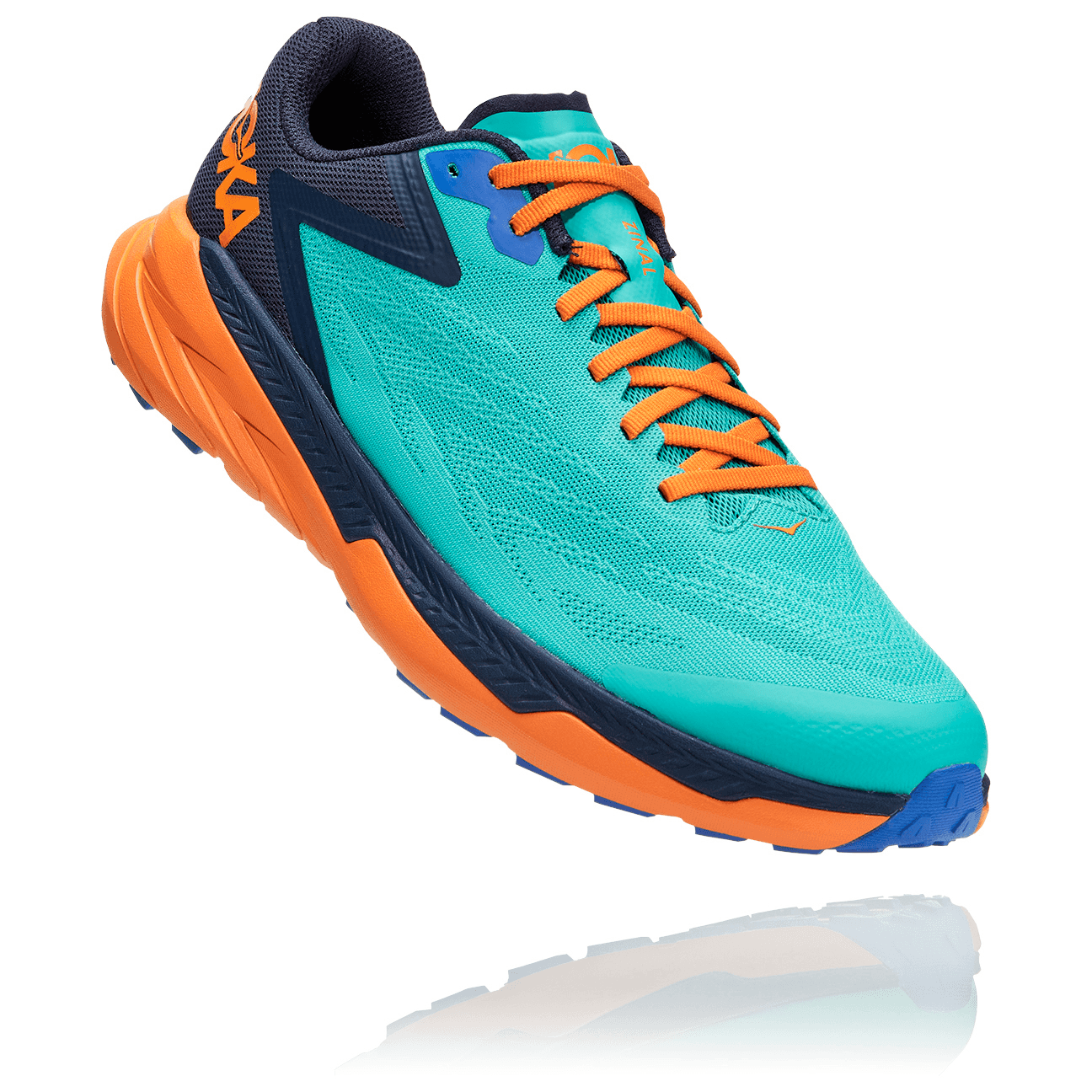 Hoka One One Zinal
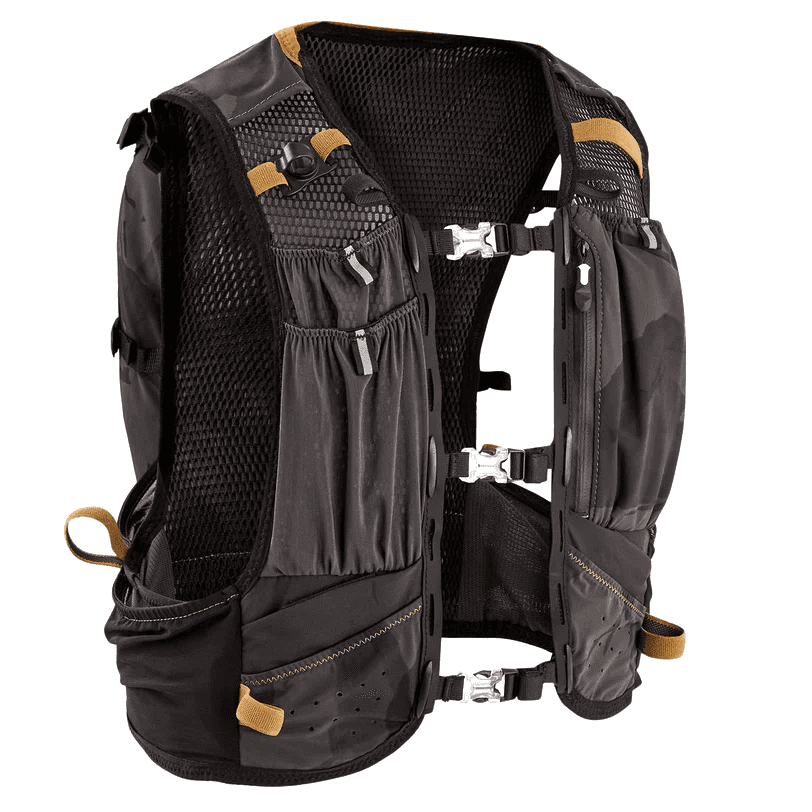 Evadict Ultratrail bag 15L
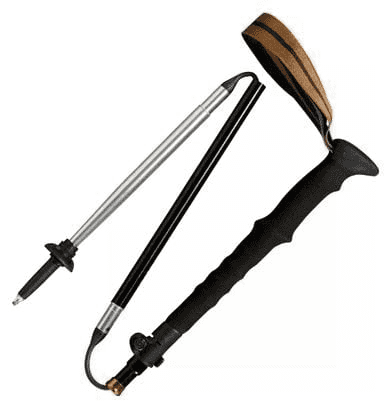 Forclaz MT500 Hiking Pole
💦 Water
I carried a Decathlon Kiprun 2L water bladder for trail running 2L, and two Decathlon Kiprun soft trail flash 500ml and only filled them with regular water. I did not have straws, but at the end of the race my neck was so stiff that I could see the use of them. Fully filling everything up definitely makes your bag feel clunky, but if you decide not to, at a certain stage, make sure to know what is ahead of you until the next station, because running out of water in this terrain is like running out of gas. I did not rely on alpine streams do refill.
I did carry the mandatory personal beaker, also from Decathlon, the Kiprun foldable drinking cup X-Light Cup. Bringing a cup is a must, because the soup is great, and it only weighs 10g.
☔ Rain protection
I carried a rain coat, rain pants and waterproof gloves, all of which are mandatory. I did not expect rain protection to be essentia during this race, and I did not end up needing it, but the weather on mountains can change rapidly and all this rain protecive clothing is is mandatory enquipment.
First the coat from Decathlon, Quechua. It’s got a waterproof coating of 5000 mm H2O (Schmerber) and moist absorbing goating of RET=12 and weighs in at 175g. It’s hooded waterproof and breathable. The waterproofing does not adhere to the UTMB minimum recommendation of 10000 Schermber, also known as ‘hurricane waterproof’, which is exactly the reason I could not find a reasonable rain coat that fitted this requirement.
The pants were also Decathlon, Quechua rain pants for hiking NH500. They have also got a waterproof coating of 5000 mm H2O (Schmerber) and moist absorbing goating of RET=12 and weigh in at 200g. If your roll the coat and pants reasonably tightly, both fit in the coat’s pocket.
Finally my waterproof gloves, also from Decathlon, Forclaz adult mountain trekking over-gloves MT500 Waterproof black. I bought them in XL so they easily fit over my fleece gloves. These actually are 10000 Schmerber and weigh only 40 grams.
🧣 Warm clothes
My set of warm clothes consisted of gloves, a buff and a Swix headband. Although I did not end up needing my warm cloths during this race, they are mandatory. Gloves were the Decatchlon Forclaz Fleece MT100. They are cheap, soft, and have a nice long lenght over the wrist. I always size up because tight gloves are worse insulators. The buff was just a thin one, and the headband instead of a beany I though was just stylish and I was not planning on using it anyways.
💡 Torches
Since this race started at 8am, I did not expect running much in the dark. I figured a simple head lamp and some precautions for the thing dying would do. My primary headlamp was a Decatchlon Forclaz HL900 USB V2 400LM.
It is important to note that, although its name suggests 400 lumen, this is its maximum output, which it will only sustain for ten second bursts. It can deliver the 200 lumen that UTMB recommends, but it will do so for 3 hours a charge. In the newer version (HL900 V3) this 200 lumen 3 hour mode has been replaced with a 350 lumen light. Altough running on the 80 lumen setting may often seem enough, is does reduce perception and may increase the risk of injury. For example, a Brazilian UTMB runner was fatally injured at 1:30am, only 23 miles into the race (Runners World) in 2022.
To enable the torch running at at least 200 lumen all night, this torch is that it comes with an AAA pack in addition to its rechargable battery. With this pack, a couple of AAA batteries will last you a night. As a mandatory backup torch I carried the cheapest battery powered head lamp from Decathlon that also ran on AAA batteries. I could probably get something lighter but this is what I had laying around.
👕 Clothes
My general set of clothes consisted of a sleeved shirt, running tights, sunglasses, sleeves and a wind stopper. First, I would discourage anyone from going sleeveless, for two reasons. First, because of the sun. Even though I put SPF 50 everywhere, was pretty tan and do not burn all too quickly, I did catch too much sun in my face on race day. I cannot imagine how my shoulders would have felt. Second, chafing of your trail running bag along the thin straps of sleeveless shirts. I cannot stress enough that chafing is something that can bring the most hardened athlete down. This is also why I prefer running tights: They don’t have an inner, and inners have seams that can also lead to chafing. I did not go for specific trailrunning pants because the vest has plenty of pockets.
To stay warm before the start and after sunset, I wore arm warmers and an BTWIN ultralight cycling wind stopper. My socks were generic, low, running socks. I did not suffer much from sand or debris getting into my shoes as the terrain is rather rocky.
Finally, my stylish sunglasses almost cost me my race, or more. Wearing sunglasses was nice during the early sunny bits of the race, however, they gradually got more dirty, which I did not notice. At some point, halfway in the race, I tripped and fell softly on probably the only grassy patch along the route. Things could have gone very differently. As I recuperated I realised the danger these dirty sunglasses had put me in, and the fact that they were not even essential anymore. So, don’t carry an expensive pair and be critical about their cleanliness.
🛠️ Other
This is where the real tips are at. Here a brief list of things I carried that are (Ⓜ️) or are not (⚪) mandatory.
Ⓜ️ Mylar/space blanket
⚪ Vaseline, against chafing
⚪ Painkillers (ibuprofen) and something against diarrhea
⚪ A repair kit: a sewing needle and thread, wound up in duct tape (9g)
⚪ Toilet paper, in a small bag (7g)
⚪ A few bandages (3g)
None of this is worth agonizing over on a spreadsheet: the whole care kit above weighs under 20 grams combined.
Comments