
































Login-less comments on this static site
Commenting here costs no account, no email and no confirmation link: you get a random animal avatar, and the comment becomes a public JSON file served straight from S3.
In June 2024 I ran the Ultra du Saint-Jacques, the longest race of a UTMB event in the Haute-Loire in central France, 133 kilometers from Saugues to Le Puy-en-Velay. I finished in 25 hours 29 minutes, in 470th place, after a night in the rain and a day in which I was already running on empty. Thirty percent of the starters that year did not finish. This post is the story of that day, and a list of the specific things I would do differently, for anyone looking at the same race. I will go over the environment, the numbers, the trail, and the gear.
The Trail du Saint-Jacques by UTMB is built around the pilgrimage route to Santiago de Compostela: the courses follow the historic GR65 path in reverse, and all of them finish at the foot of the cathedral of Le Puy-en-Velay. The event runs four races over one weekend. The Ultra is the long one, and the only one that starts at night. A bus takes you out to the village of Saugues, you spend the afternoon trying and failing to relax, and you start in the dark. My start time was Friday 14 June 2024 at 22:05, and my finish came the next evening. The three shorter races start in the morning, which turned out to matter a great deal.
Two years earlier I had run my first UTMB race, the 76 km X-Traversee in Verbier, and it had gone better than it deserved to. I had done no ultra-specific training and had ridden a 240 km cyclosportive the week before, and I still finished. What that race did teach me was how badly I estimate finish times: I had expected roughly 12 hours and needed nearly 16. The average finisher there takes about 17. Had I already built the UTMB race finder at that point, I could simply have looked that up.
I wanted to move up to UTMB’s longest category, which the organisation labels 100M. The obvious step from Verbier would have been the X-Alpine, the big brother of the race I had done, at roughly 140 km with 9,000 meters of climbing. That still looks bonkers to me. Saint-Jacques looked like the reasonable version of the same ambition: hilly rather than alpine, and 133 km rather than the 170 km some races in that class run. That reasoning was not wrong, but it was not the easy option either: the share of starters who fail to finish here, in the table below, runs higher than in Verbier.
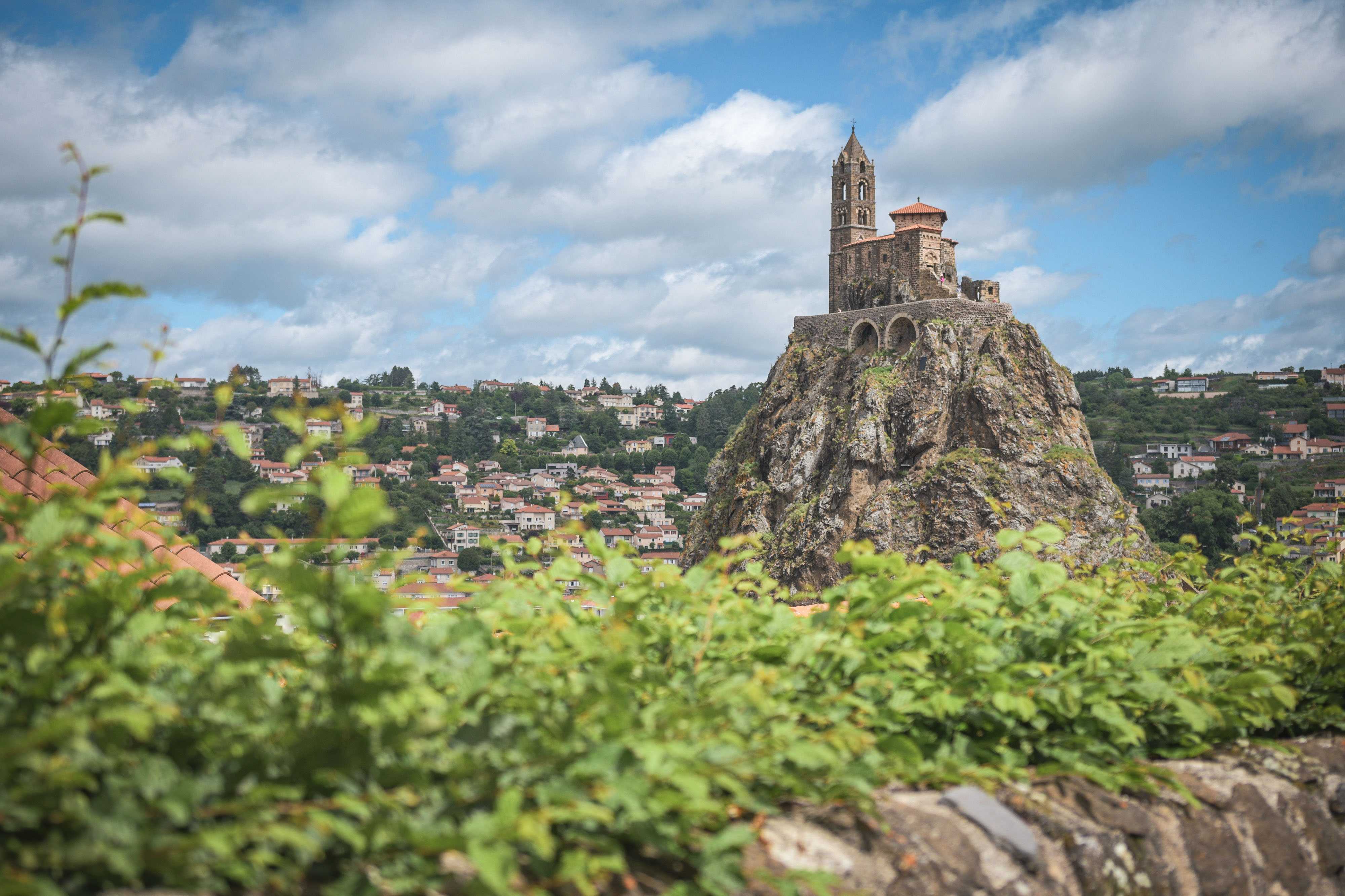
The chapel below is the landmark of the finish town, and the map under it is the course I had signed up for: a long westward loop from Saugues down to the Allier gorges and back up onto the plateau before dropping into Le Puy-en-Velay.
It is a well organised race with a 27-hour cutoff, and the numbers show it is a genuinely hard one. The course has grown almost every year, from 104 km and 3,080 meters of climbing in 2016 to 131 km and 5,500 meters in the year I ran it, and the field has grown with it, from 45 runners to nearly a thousand. What stands out is the failure rate: once the course passed 120 km, between a quarter and a third of the field stopped short of the finish every year, and 2025 reached 37 percent.
| Year | Distance (km) | Elevation (m) | DNF rate (%) | Mean finish time | Participants |
|---|---|---|---|---|---|
| 2016 | 104 | 3,080 | 0 | 15:44 | 45 |
| 2017 | 111 | 3,260 | 22 | 17:44 | 104 |
| 2018 | 113 | 3,650 | 24 | 18:07 | 126 |
| 2019 | 117 | 4,450 | 23 | 20:01 | 180 |
| 2021 | 116 | 4,380 | 17 | 19:27 | 151 |
| 2022 | 124 | 5,150 | 28 | 22:30 | 391 |
| 2023 | 127 | 5,250 | 25 | 22:03 | 557 |
| 2024 | 131 | 5,500 | 30 | 23:34 | 998 |
| 2025 | 137 | 5,200 | 37 | 24:08 | 832 |
| 2026 | 140 | 6,000 | 34 | 25:04 | 922 |
The row for my year says 131 km and 5,500 meters; the timing sheet I ran against measured the same course at 133 km and 5,923 meters. Courses are re-measured and slightly rerouted all the time, so treat any single distance as an approximation. For numbers like this across the whole UTMB calendar rather than one race, see my UTMB race finder.
My checkpoint times tell the story of the day better than I can. Through the night I was still moving well: Saint-Julien-des-Chazes at 18 km after 2 hours 5 minutes, Prades at 41 km after 6 hours. Then it fell apart. Alleyras at 84 km took 14 hours 48, Lac du Bouchet at 100 km took 18 hours 24, and the final 33 km took almost seven hours on their own. Mean finish time that year was 23:34, so I came in about two hours slower than the average finisher.
There is no single decisive climb here, nothing like the thousand-meter wall that defines the closing stretch in Verbier. It is relentless up and down instead, gorges and plateaus, and in 2024 the mud supplied the difficulty that the rocks do elsewhere: it got thick enough to hold a foot and pull the shoe. It is honestly not scenery I remember well, partly because I ran the beautiful half of it in the dark and the rest of it hollowed out. It is mentally grueling terrain more than it is spectacular terrain.
The profile below plots the whole course with my pace as the color of the line, and it is an unusually blunt picture of a race going wrong: the light, quick section covers the night, and from roughly the first marathon onward the line stays dark all the way to Le Puy-en-Velay.
My preparation had been a half-marathon block, not an ultra block. I ran the Zwolle half marathon on 8 June, six days before the start, in 1:22, which was decent road form for me at the time and is about six minutes slower than I run it now. My reasoning was that if I was simply fit, and my gear was sorted, the distance would take care of itself. The chart below is what that reasoning looked like in kilometers.
Fifteen weeks of that is plotted above. There are two good weeks over 100 km at the end of April and the start of May, and then the volume falls away: 60 km, then 24 km, then 45 km, then the half marathon week at 61 km. That is reasonable preparation for a fast half marathon and thin preparation for 133 km with 6,000 meters of climbing. There was no training camp, no long back-to-back days in similar terrain, and not enough hours spent in the exact kit I would be carrying.
The elephant in the room on race night was the weather. It began raining as we left and it rained until morning. At one point it came down so hard that my headlamp lit up the rain itself and I could barely make out the trail. A runner near me slid off the edge of the path into the bushes below, and two of us hauled him back up by the hands, covered in mud. You spend the first few minutes carefully trying to keep your feet dry, and then your shoes fill and there is nothing left to protect. In the photo below I am still smiling, which places it early enough in the night for that to be true.
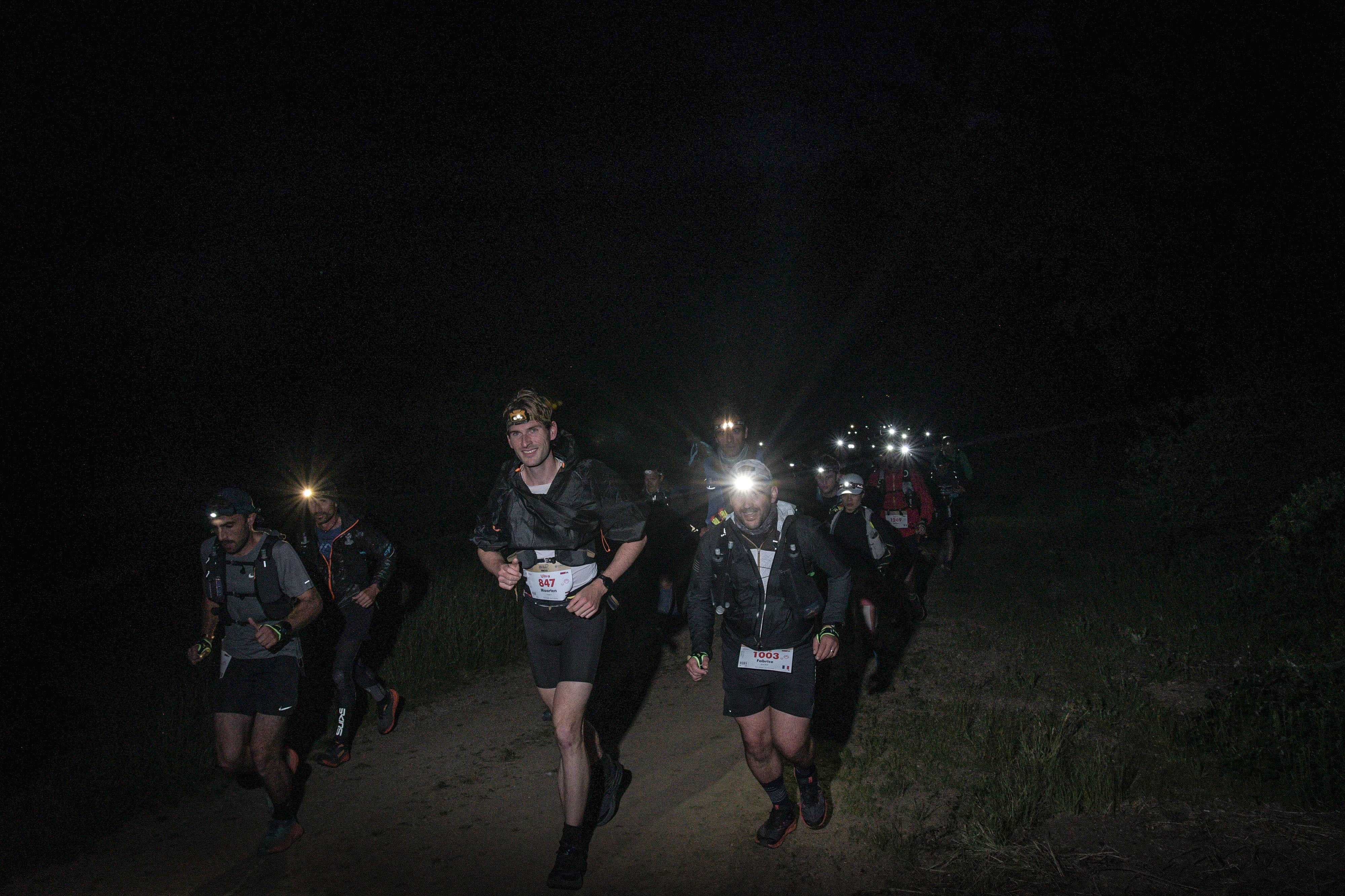
I noticed that I was staying close to the people with strong lights, because their beam was better than mine. I was carrying the same Decathlon Forclaz HL900 headlamp I had used in Verbier, with spare AAA batteries. At some point in the night, more suddenly than I expected, it went out, and I had never practised changing it over. A stranger stopped in the rain and held his own light on me while I fumbled the battery pack in. Kind of him, embarrassing for me, and entirely avoidable.
Morning arrived dry and mild, and the day was genuinely pleasant. My rain jacket had no zip at the front, so I could pull it over myself and my pack in one motion, and my upper body stayed dry all night. I was never cold once. The runners who started the shorter races that morning got the good weather for their whole race.
The problem was that I was already too tired. After the first marathon of the race I sent videos home to show my family I was still alive, and watching them back, my speech is already slightly slurred at 42 km. A third of the way in, I was already half spent, and I burned the rest somewhere between 80 and 100 km. I was not nauseous and my stomach was fine; I was sleepy and I was simply hollow. I do not remember walking much on the flat, but the climbs must have taken everything, because there was nothing left to give them.
I stopped properly only once, at Saint-Christophe-sur-Dolaizon at 118 km, some 20 hours in and just before dark, and I ate pasta, and it was wonderful. What strikes me at aid stations in these races is how long people stay. There were runners lying flat on the floor, taking their time, and I was still impatient to move even though I had long since given up on my target time. That is a biased sample, of course, because the people who come and go quickly are the ones you never notice. By then I had stopped racing the clock entirely and was in pure survival mode, focused only on finishing.
The last 30 km took the time they took. Then the streets of Le Puy-en-Velay, the cathedral, and the finish line in the dark, half an hour before the day ran out, which is the photo below.
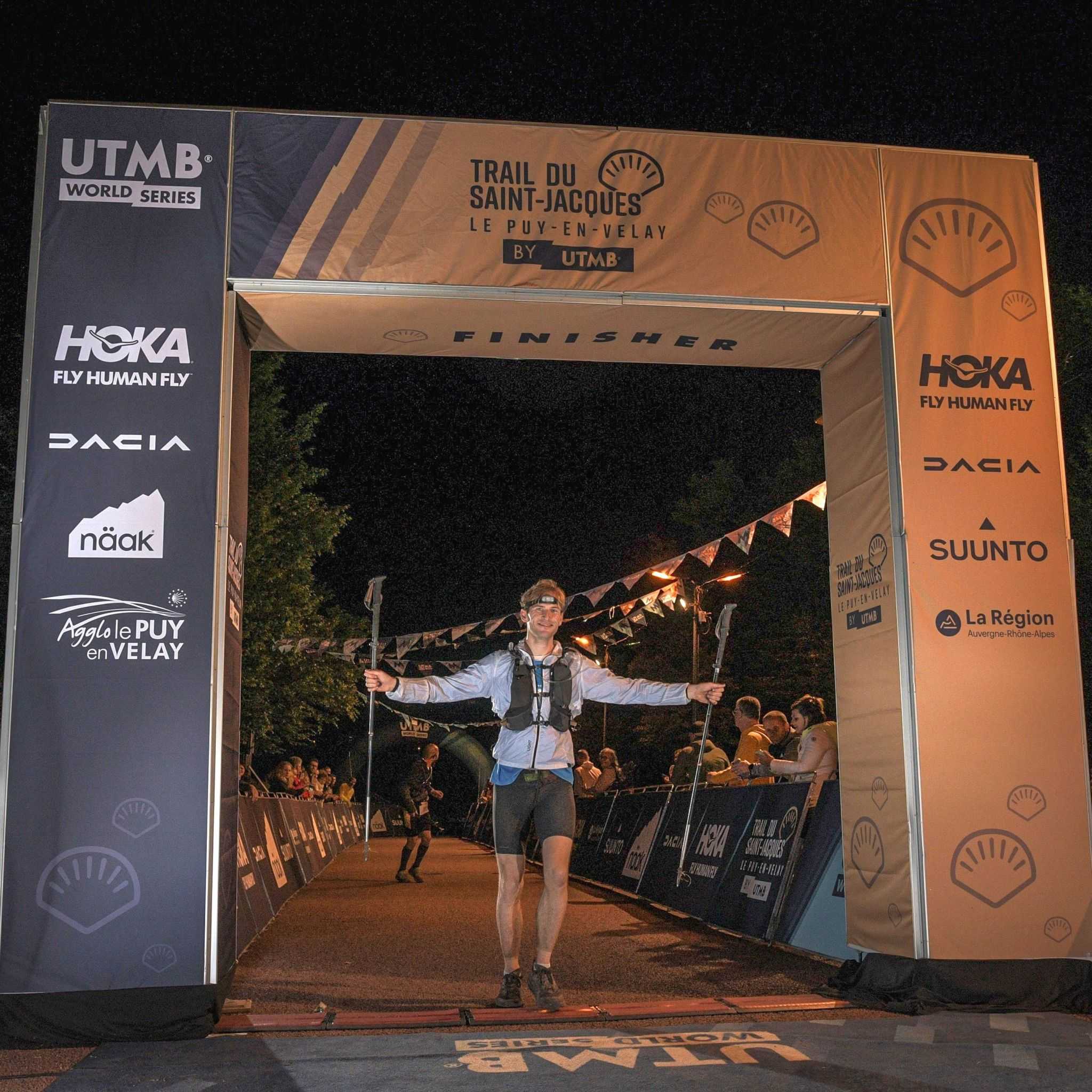
Physically I was in a bad state afterwards, and I ran a mild fever for two days. Someone drove me back to where we were staying, the shower was extraordinary, and I could barely stay upright in it. After 25 hours of moving, lying down in a bed knowing that you do not have to go anywhere for as long as you like is the single best feeling I have ever had. Better than the finish line, better than the shower. I spent the next two days in that bed.
I said afterwards that I was never doing this again. I am writing this while preparing for the next one, so we will see whether the lessons took.
Three things I would do differently, in order of how much they cost me.
Light. My previous UTMB race started at 8 in the morning and I barely needed a lamp; this one starts at 10 in the evening and gives you a full night of it. The Forclaz HL900’s name refers to a 400 lumen burst it can only hold for a few seconds. It will run at the 200 lumen that UTMB recommends for about three hours on the rechargeable pack, after which the plan was to swap in lithium AAA batteries. In practice that meant a hardware change in heavy rain, in the dark, with cold hands, having never done it before. Carry a lamp that can give you a usable beam for the whole night, practise the battery change before you need it, and do not quietly plan on borrowing other people’s light.
Drop bag. The race gives you a bag that you get back midway through the course. I put only food in it. My only prior experience with drop bags was from triathlon, where whatever you leave in the box is gone unless you carry it out, so it never occurred to me to pack things I might not use. Other runners had put dry shoes and socks in theirs, and picking those up in the middle of a muddy day is a real morale boost, even if the fresh pair is soaked again within the hour, and it is exactly what you want available if you are developing a serious blister. Next time it gets dry shoes, dry socks and food I already know I can digest. No spare hardware beyond that: I do not expect equipment to break, and what I do worry about, I carry a backup for.
Distance. A 1:22 half marathon six days out does not prepare you for 133 km. Two weeks over 100 km in spring, followed by a taper-shaped dip through May, is not enough time on feet, and I paid for it from the first marathon onward. More volume, some long days in comparable terrain, and rehearsing the gear are the three things that would change the day.
Everything else held up. The cheap jacket kept me dry and warm all night, and I never touched the spare socks in my pack, because in that mud they would not have lasted an hour. What failed was energy, light, and my own refusal to use the drop bag the organisation had already handed me.